The work we do in the MInDS research group is interdisciplinary, and involves both extending theory and applying theoretical advancements to real-world problems. We categorise some of our outputs by research areas currently active within the group.
Bayesian networks applied to diverse problems
- Agricultural development: Published in Expert Systems with Applications, by B. Yet et al., 2016.
- Betting market efficiency: Published in Journal of Sports Analytics, by A. Constantinou, 2022.
- Diabetes: Published in IEEE 9th International Conference on Healthcare Informatics, by M. Neves et al., 2021.
- Endometrial cancel: Published in Journal of Biomedical Informatics, by A. Zanga, et al., 2025.
- Finance: Published in Risk Analysis, by M. Neil et al., 2005.
- Football predictions: Published in Machine Learning, by A. Constantinou, 2019.
- Forensic psychiatry: Published in Artificial Intelligence in Medicine, by A. Constantinou et al., 2016.
- Inspection and Maintenance: Published in Reliability Engineering & System Safety, by H. Zhang and W. Marsh, 2021.
- Gaming (Hattrick football manager): Published in Entertainment Computing, by A. Constantinou, N. Higgins, and N. Kitson, 2026.
- Legal reasoning: Published in Cognitive Science, by N. Fenton et al., 2013.
- Musculoskeletal health: Published in the European Federation of Medical Informatics, by B. Yet at al., 2018.
- Product safety: Published in Journal of safety research, by J. Hunte et al., 2022.
- Property market: Published in PLoS ONE, by A. Constantinou and N. Fenton, 2017.
- Rail maintenance: Published in Safety and Reliability, by W. Marsh et al., 2016.
- Reoffending in prisoners: Published inExpert Systems with Applications, by A. Constantinou et al., 2015.
- Rheumatoid arthritis: Published in IEEE International Conference on Healthcare Informatics, by A. Fahmi et al., 2020.
- Software engineering: Published in IEEE Transactions on Software Engineering, by N. Fenton and M. Neil, 1999.
- Trustworthiness in medicine: Published in Artificial Intelligence in Medicine, by Evangelia Kyrimi et al., 2020.
- Warfarin therapy: Published in Decision Support Systems, by B. Yet et al., 2013.
Machine Learning (Predictive and Causal)
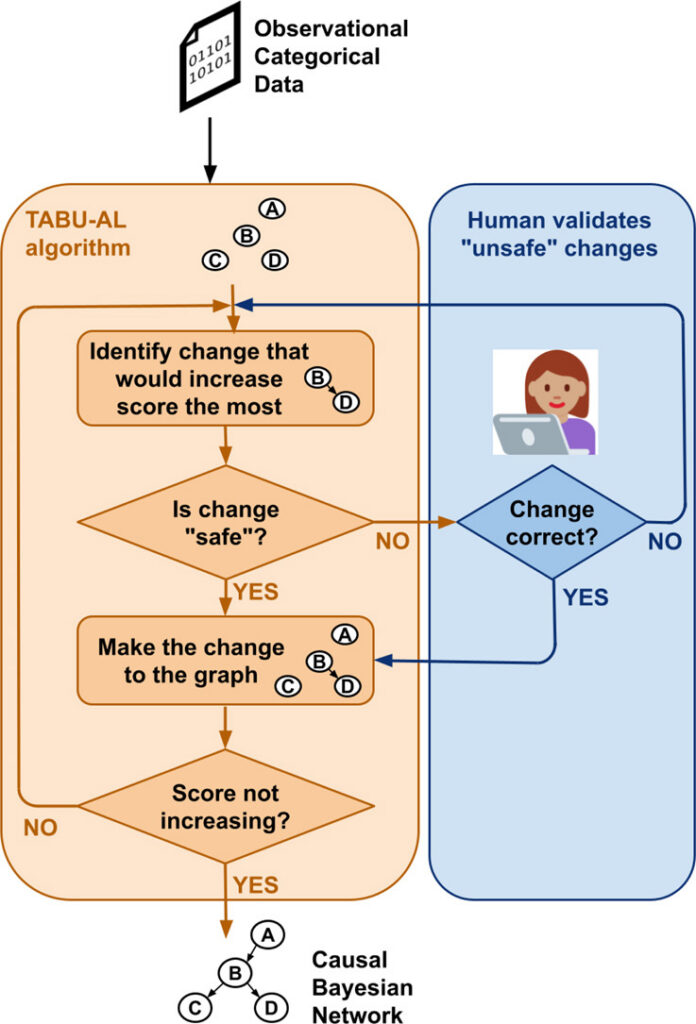
- Causal structure learning has traditionally taken one of two approaches: (a) extracting structure from data using machine learning or (b) integrating pre-existing human knowledge to guide structure learning. But what if the algorithm itself could decide when and where human input is needed? This work challenges this traditional approach by allowing the algorithm to actively seek human input only when it encounters uncertainty. The results show improved accuracy, more efficient use of human expertise, and a learning process that is both more transparent and interpretable. Published in Knowledge-Based Systems, by N. Kitson and A. Constantinou, 2025.
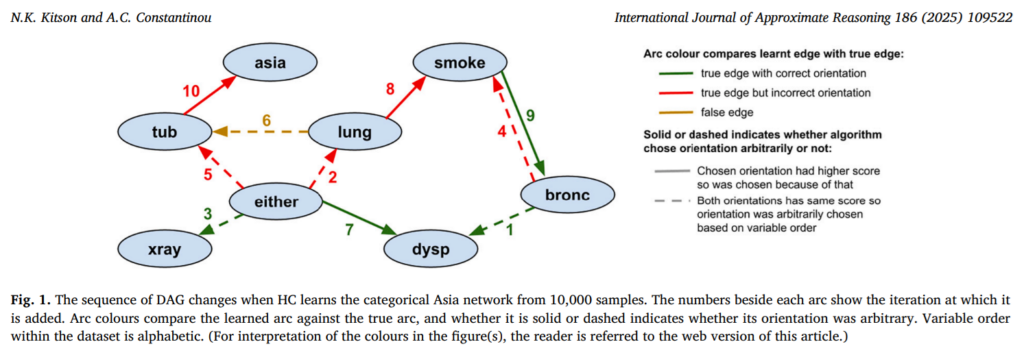
- PC-Stable (partially) solved the unusual problem where learnt causal structures would change simply because the columns in a dataset were reordered. But the same issue exists in score-based algorithms like hill-climbing and Tabu search, and it has been largely ignored for decades. This work introduces HC-Stable and Tabu-Stable; two algorithms that offer complete stability under column reordering, and improved (though not optimal) accuracy compared to their widely used but unstable counterparts. Published in Expert Systems with Applications, by N. Kitson and A. Constantinou, 2025
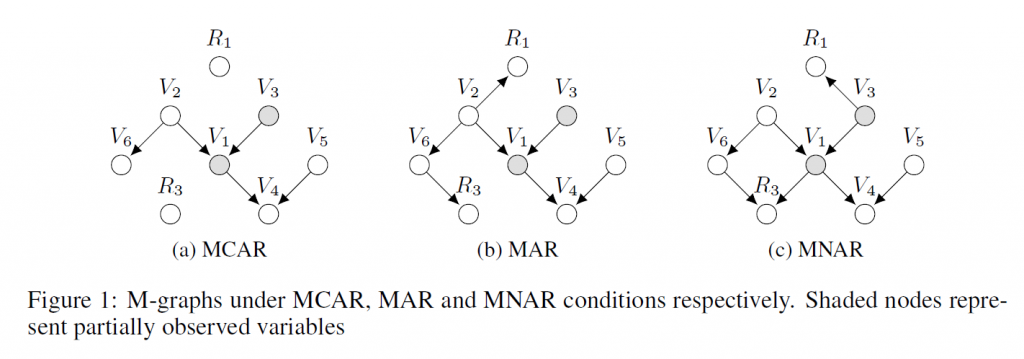
- Improving the imputation of missing data values with Markov Blanket discovery, when missing values are Missing Completely At Random (MCAR), Missing At Random (MAR), and Missing Not At Random (MNAR). In Proceedings of the 11th International Conference on Learning Representations (ICLR-2023) (link), by Yang Liu and Anthony Constantinou.
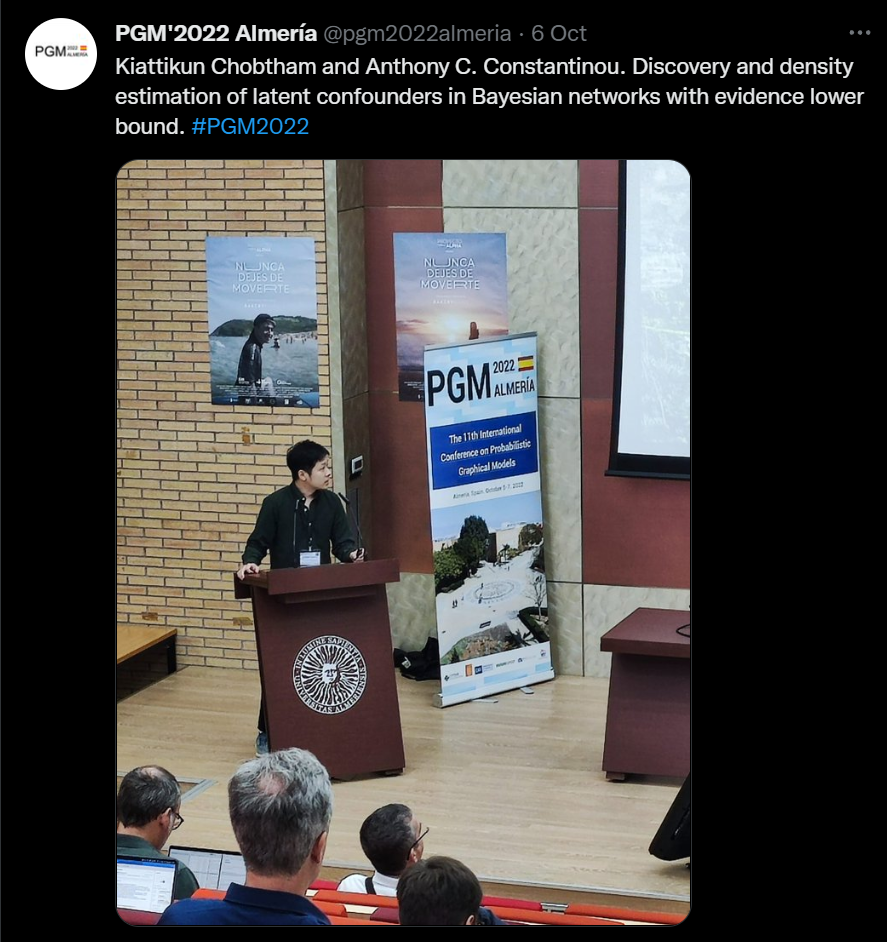
- Discovering and parameterising latent confounders by combining elements of variational Bayesian methods, expectation-maximisation, hill-climbing search, and structure learning under the assumption of causal insufficiency. Published in Proceedings of the 11th International Conference on Probabilistic Graphical Models (link), by Kiattikun Chobtham and Anthony Constantinou, 2022.
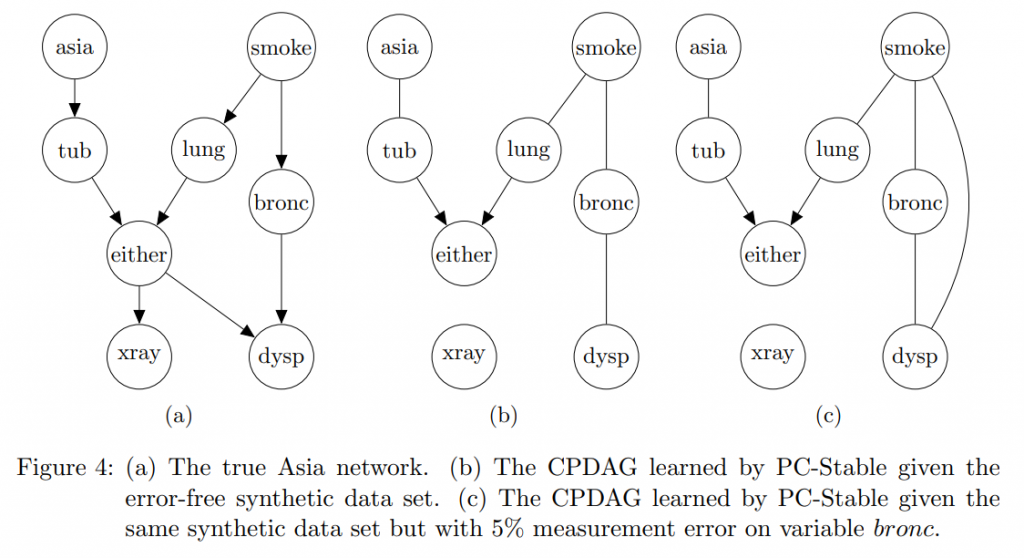
- Improving BN structure learning in the presence of measurement error. Published in the Journal of Machine Learning Research (link), by Yang Liu et al., 2022.
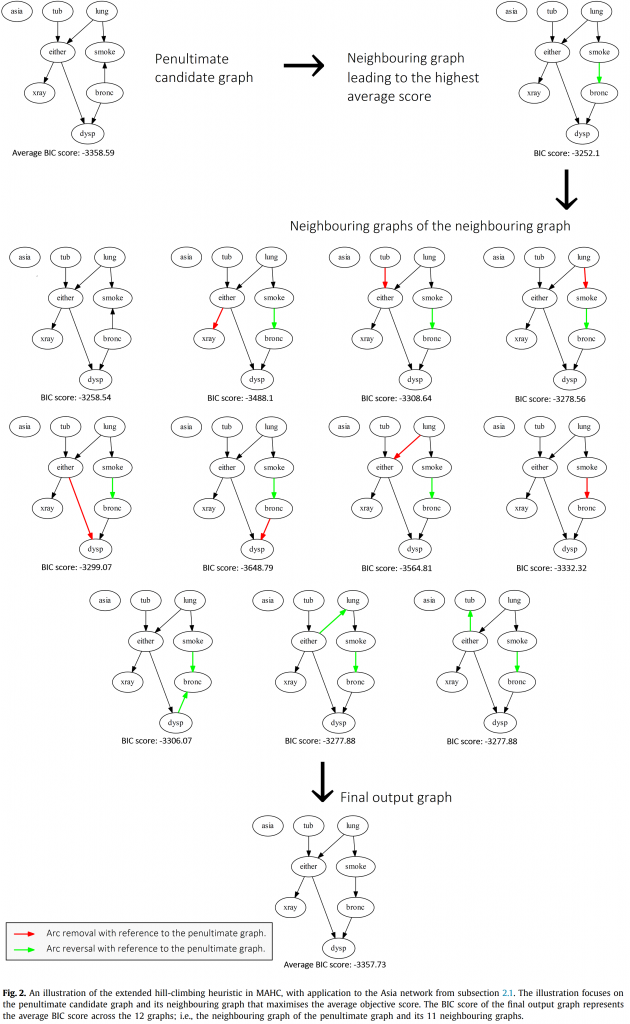
- Combining strategies that prune the search space of candidate graphs with model averaging, to learn BN structures in the presence of data noise. Published in the International Journal of Approximate Reasoning (link), by Anthony Constantinou et al., 2022.
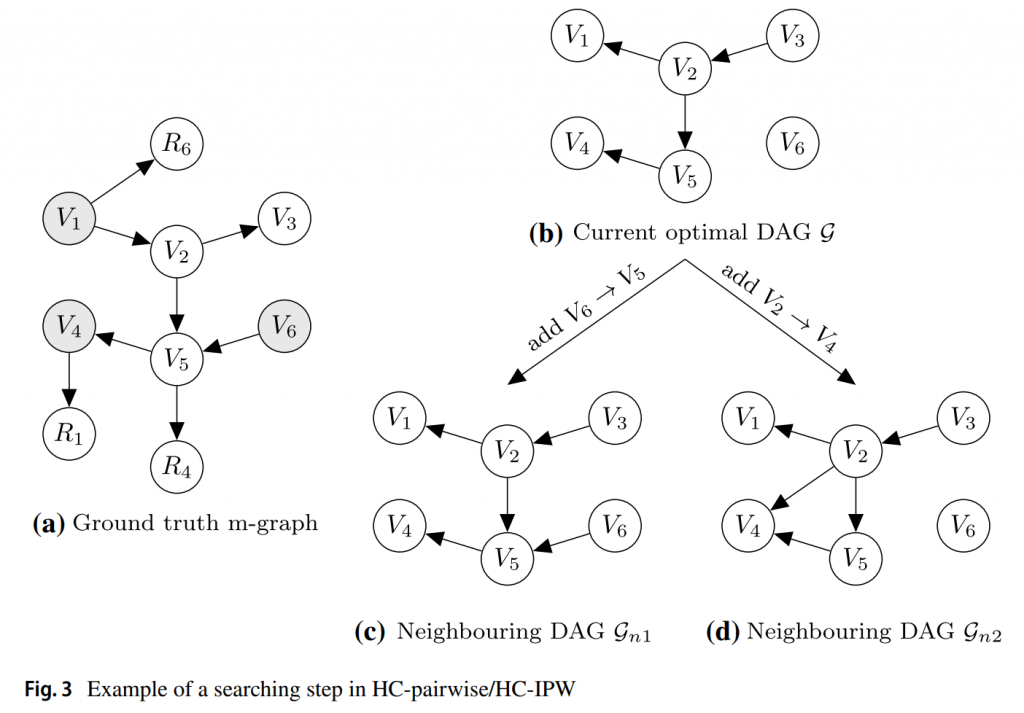
- Combining greedy search with pairwise deletion and inverse probability weighting to improve structure learning when the input data contain systematic missingness. Published in the Machine Learning journal (link), by Yang Liu and Anthony Constantinou, 2022.
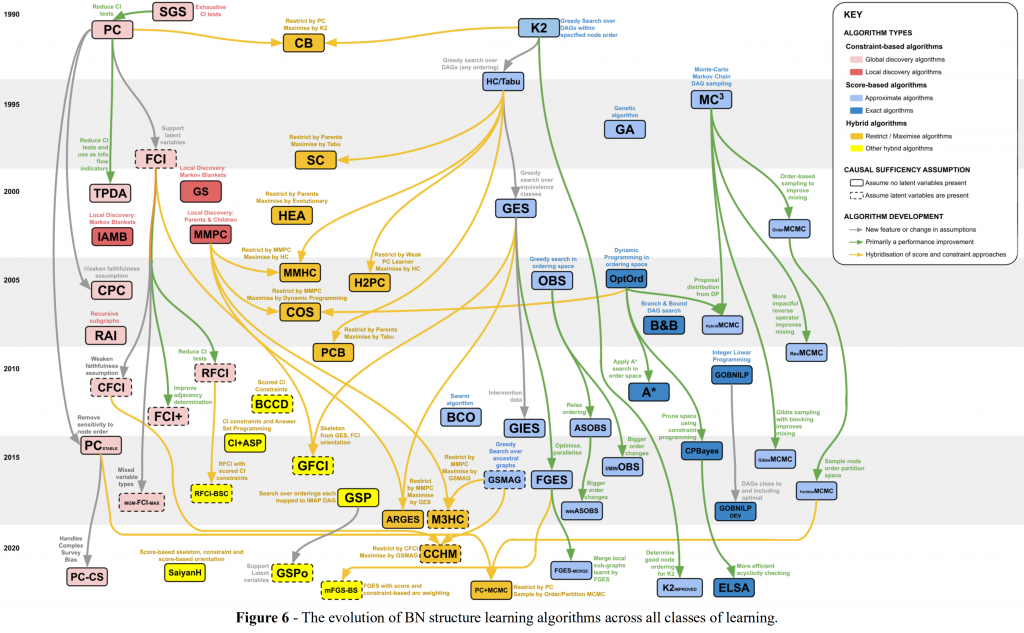
- A comprehensive review of 74 algorithms proposed for learning graphical structures. The basic approach of each algorithm is described in consistent terms, and the similarities and differences between them highlighted. Methods of evaluating algorithms and their comparative performance are discussed including the consistency of claims made in the literature. Approaches for dealing with data noise in real-world datasets and incorporating expert knowledge into the learning process are also covered. To appear in Artificial Intelligence Review (link), by Ken Kitson et al., 2022.
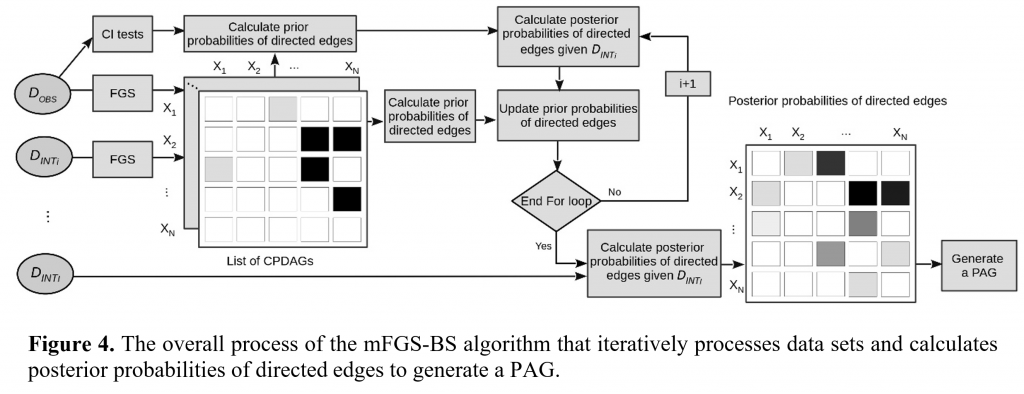
- Estimating edge probabilities to produce a PAG from multiple interventional and observational data sets, in the presence of latent confounders. Published in the Data Mining and Knowledge Discovery journal (link), by Kiattikun Chobtham et al., 2022.
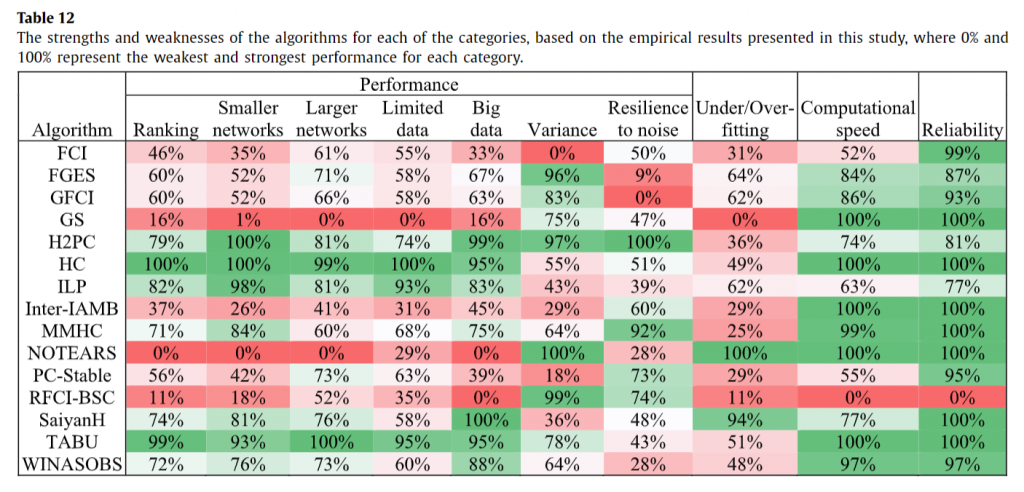
- Empirical validation of BN structure learning algorithms with noisy data, with results showing that traditional synthetic performance may overestimate real-world performance by anywhere between 10% and more than 50%. Published in the International Journal of Approximate Reasoning (link), by Anthony Constantinou et al., 2021.
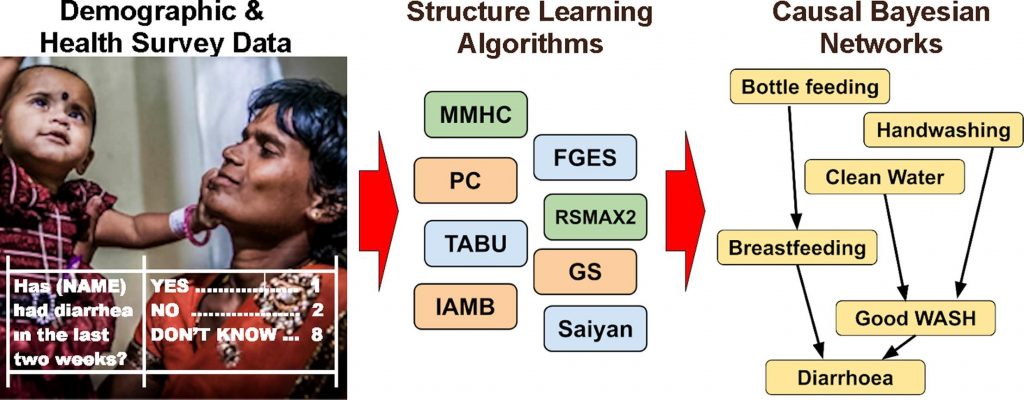
- Application of BN structure learning to demographic and health survey data. Published in the Journal of Biomedical Informatics (link), by Ken Kitson and Anthony Constantinou, 2021.
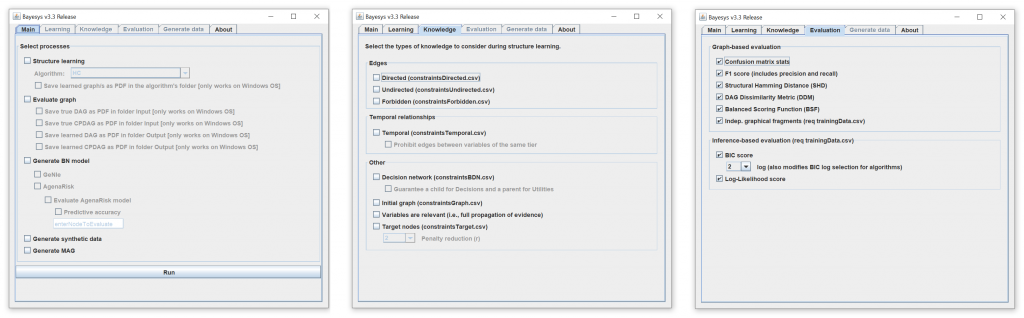
- The open-source Bayesys structure learning system, developed by Anthony Constantinou. Link to Java project, manual and repository.